
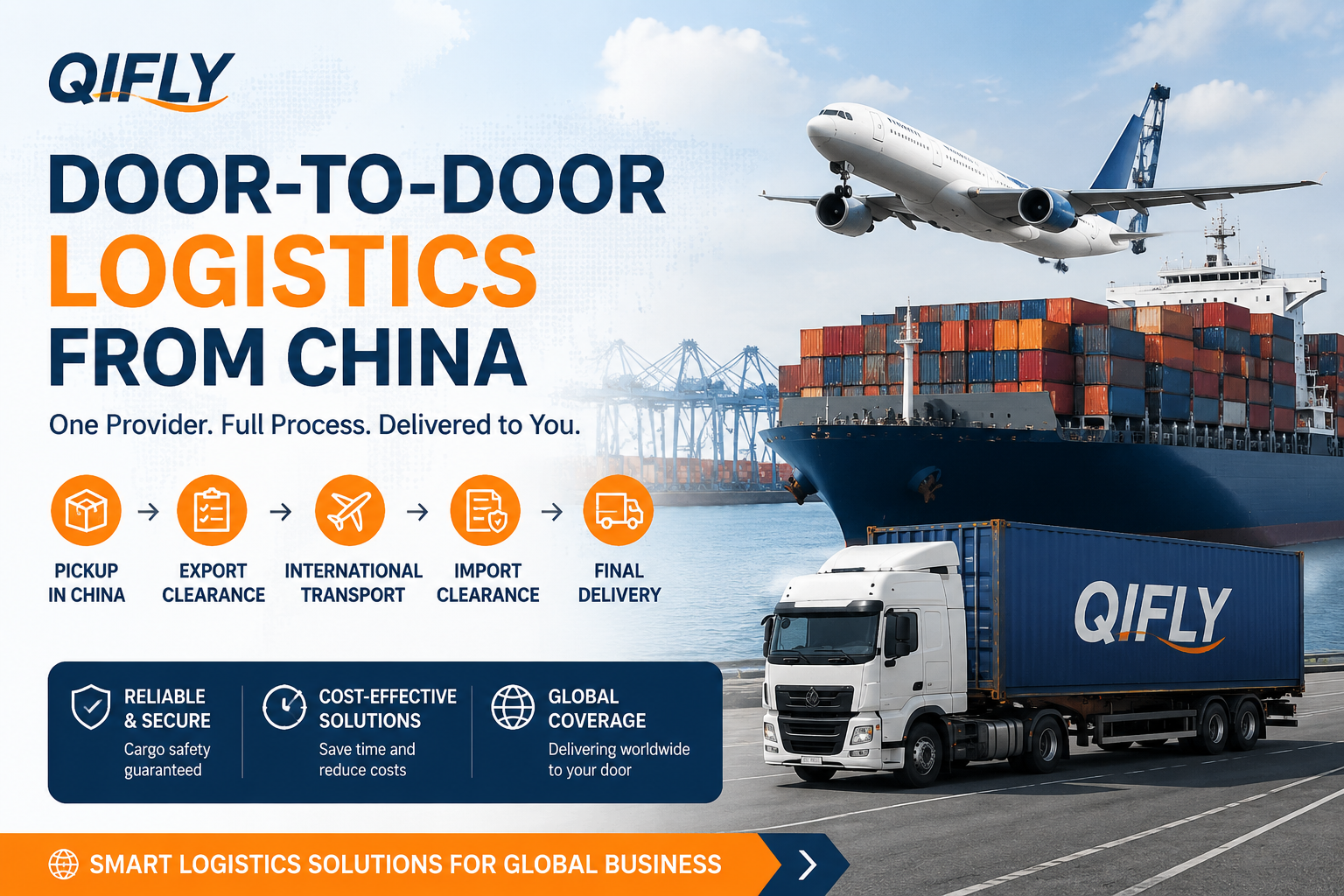
Door-to-door logistics from China has become one of the most efficient ways for global businesses to move goods internationally. Instead of coordinating multiple carriers, customs brokers, and delivery providers, companies now rely on one integrated system that manages the entire journey from pickup in China to final delivery overseas.
As a result, importers, eCommerce sellers, and manufacturers gain better control over time, cost, and delivery stability.
What Door-to-Door Logistics from China Includes
Door-to-door logistics covers every stage of the shipping process. In other words, it connects the full supply chain under one service.
Typically, it includes:
- Pickup from supplier or factory in China
- Export customs clearance
- International shipping by air or sea
- Import customs handling in the destination country
- Final delivery to warehouse, Amazon FBA, or business address
Moreover, this structure removes the need to work with multiple service providers.
QIFLY integrates these steps into one coordinated system, which helps businesses reduce operational complexity.
Why Businesses Use Door-to-Door Logistics from China
Global supply chains continue to become more complex. Therefore, companies increasingly prefer logistics solutions that reduce management effort.
Door-to-door logistics solves several key problems:
It simplifies operations
Instead of managing separate providers, businesses work with one logistics partner.
It improves delivery efficiency
Because fewer handovers happen, shipments move faster and face fewer delays.
It increases cost predictability
In addition, businesses receive more stable and transparent pricing.
As a result, companies can focus more on sales and growth rather than logistics coordination.
How Door-to-Door Logistics from China Works
Although the service looks simple from the outside, several coordinated steps happen behind the scenes.
Step 1: Pickup in China
First, the supplier hands over the cargo. The logistics team then collects and transports it to a consolidation warehouse.
Step 2: Export processing
Next, export documents are prepared and verified. This step ensures compliance with international shipping regulations.
Step 3: International transportation
After that, cargo moves through air freight or sea freight depending on urgency and budget.
Step 4: Import clearance
Once the shipment arrives, customs authorities review documents and classify the cargo.
Step 5: Final delivery
Finally, goods are delivered directly to the destination address, such as warehouses or fulfillment centers.
Door-to-Door Logistics vs Traditional Shipping Models
To understand its value more clearly, it helps to compare it with traditional shipping.
Traditional model (Port-to-Port)
- Businesses manage multiple service providers
- Importers handle customs separately
- Communication often becomes fragmented
Door-to-door model
- One provider manages the full process
- Communication stays centralized
- Delays and errors decrease significantly
Therefore, door-to-door logistics has become the preferred model for many international traders.
When Door-to-Door Logistics Makes the Most Sense
This logistics model works especially well in several business scenarios.
Cross-border eCommerce
Sellers benefit from faster replenishment and simplified shipping workflows.
Amazon FBA shipments
Goods can move directly into fulfillment centers with fewer steps.
Small and medium importers
Businesses avoid the need for in-house logistics expertise.
Manufacturing supply chains
Companies maintain stable and predictable import cycles.
Cost Structure of Door-to-Door Logistics from China
The total cost usually includes several components. However, providers often combine them into one quotation for simplicity.
Typical cost elements include:
- Domestic pickup in China
- International freight (air or sea)
- Customs duties and clearance fees
- Final delivery charges
In addition, pricing depends on cargo type, volume, and destination.
Common Issues in Door-to-Door Shipping
Even though the process is simplified, problems can still occur if planning is not correct.
Incorrect cargo classification
This may cause customs delays or extra charges.
Documentation errors
Small mistakes in invoices or packing lists can slow down clearance.
Poor packaging decisions
Improper packaging can increase volume weight and shipping cost.
Wrong shipping method selection
Choosing air or sea freight without planning can increase total cost.
Therefore, coordination plays a critical role in efficiency.
QIFLY Door-to-Door Logistics Solutions
QIFLY provides structured door-to-door logistics from China for global businesses.
In particular, the service includes:
- Air and sea freight integration
- Customs clearance coordination
- End-to-end delivery management
- Real-time shipment tracking
- Optimized routing and cost control
As a result, businesses gain a more stable and predictable international shipping process.
Final Positioning of Door-to-Door Logistics from China
Door-to-door logistics from China is no longer just a convenience service. Instead, it has become a standard operating model for global trade.
Ultimately, businesses choose it because it reduces complexity, improves delivery consistency, and supports scalable international growth.